

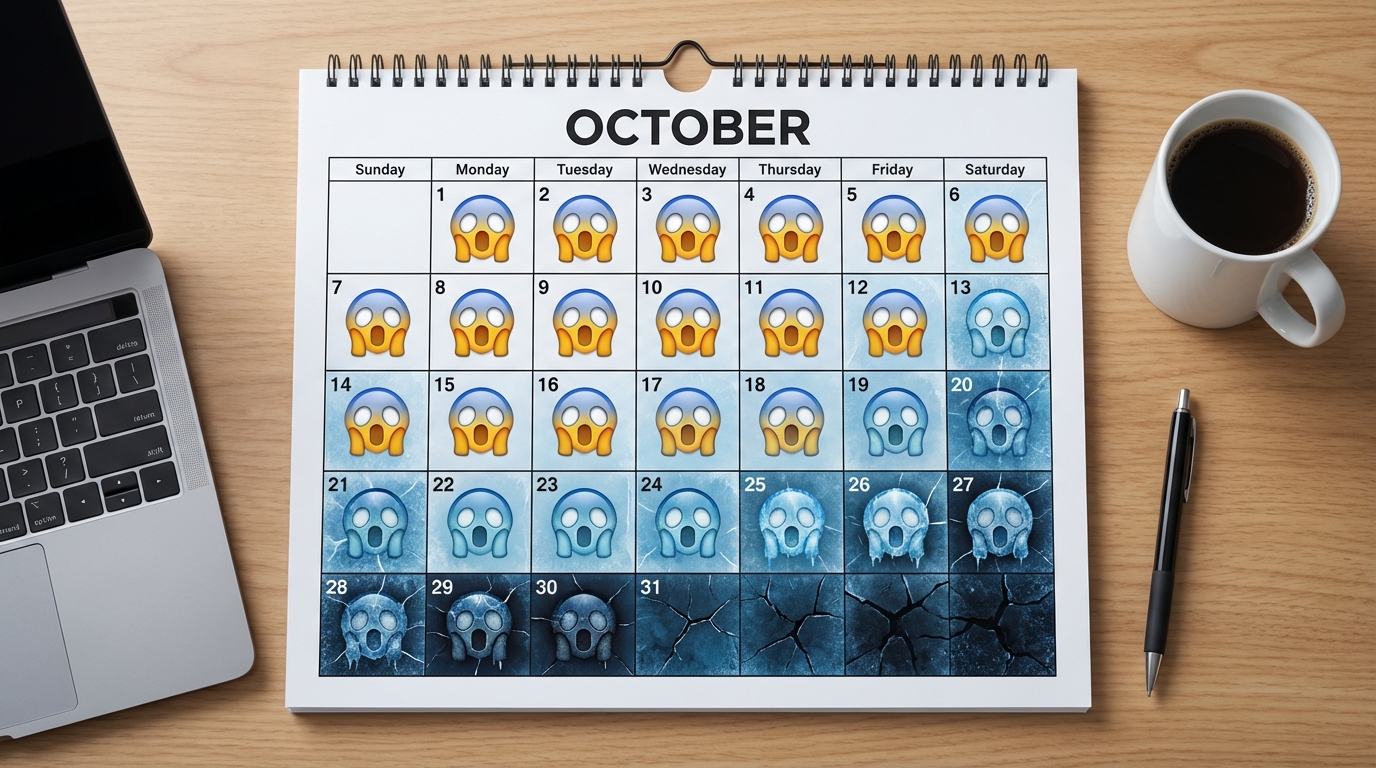
Why your last panic attack made the next one more likely—and the counterintuitive key to interrupting the pattern
You're in a meeting. Someone unexpectedly calls on you as the technical expert on something you weren't prepared for.
Suddenly your heart is pounding. You start sweating. Your vision narrows at the edges. Sounds get muffled, like you're underwater. Every cell in your body screams run.
But you can't run. You're on camera. Clients are watching. So you sit there, frozen, trying to look professional while something inside you is falling apart.
And here's the part nobody talks about: after you survive it—after the meeting ends and you can finally breathe—you don't feel relieved.
You feel more afraid. Not less.
More afraid of the next meeting. More afraid of being put on the spot again. More afraid of feeling that way again.
If that sounds familiar, you've stumbled onto something important. That pattern—surviving a panic attack but feeling more afraid afterward—is actually a clue to what's really going on.
The Hidden Panic Cycle Nobody Talks About
Most people think panic attacks work like this:
Trigger → Panic → It's Over
A scary situation causes panic. You get through it. You move on.
But that's not what's actually happening. There's an invisible mechanism running behind the scenes that explains why panic tends to get worse over time, not better.
Here's what research on panic disorder reveals:
There are actually two cycles running simultaneously.
The First Cycle:
You're in the meeting. You think: I don't know this topic. They're going to find out. I'm going to look incompetent.
That thought triggers your body's threat response. Your heart rate increases. You feel hot. Your chest tightens.
Now here's where it goes sideways.
You notice these sensations—racing heart, heat, tightness—and your brain interprets them catastrophically. Something is really wrong. I might pass out. I might have a heart attack. Something embarrassing is about to happen.
That interpretation sends another threat signal. Your symptoms intensify. Your vision starts to go. Sounds muffle. The urge to flee becomes overwhelming.
This is the vicious cycle that cognitive behavioral research has documented for decades: bodily sensations are misinterpreted as dangerous, which increases anxiety, which intensifies the sensations, which confirms they must be dangerous.
But there's a second cycle that most people completely miss.
The Second Cycle:
Think about what happens before your next high-stakes meeting.
You start getting anxious just thinking about it. You worry it'll happen again. You notice your heart speed up just anticipating being in that situation.
Do you see what happened?
You're no longer just afraid of looking incompetent. You're afraid of having another panic attack. You're afraid of the fear itself.
The feelings from the first cycle have become the trigger for the second.
This is the hidden mechanism that maintains panic over time. Researchers call it "anxiety sensitivity"—the fear of anxiety symptoms themselves. And it's the reason white-knuckling through a panic attack often makes things worse, not better.
When you survive a panic attack through sheer willpower without understanding what's happening, your brain doesn't learn "that wasn't actually dangerous." It learns "I barely survived something terrifying."
Which makes you more afraid of the next one.
Which makes the next one more likely.
Why Rational Thinking Fails During Panic
Here's something that might surprise you:
The physical sensations you experience during panic—racing heart, sweating, heat, chest tightness—are the exact same sensations you experience after a hard workout. After climbing several flights of stairs. After your morning coffee kicks in.
But you don't panic then.
Why not? Because you know why it's happening. After exercise, you know your heart is racing because you just ran, not because something is wrong.
The sensations aren't the problem. The interpretation is the problem.
So in theory, you should be able to think your way out of it. Just tell yourself it's not dangerous.
Except it doesn't work that way.
In the middle of a panic attack, your body is screaming danger. Your threat detection system is fully activated, flooding you with stress hormones, preparing you to fight or flee. Logic can't cut through that.
You need something that actually interrupts the physical cascade.
And here's where most approaches fall short.
The Internal Dialogue Mistake That Makes Panic Worse
Almost every piece of advice on managing panic focuses on the same things: breathing exercises, trying to relax, challenging your thoughts.
But there's something critical these approaches overlook entirely: what you're saying to yourself during the panic.
When you're in that spiral—heart pounding, vision narrowing—what's your internal dialogue?
For most people, it sounds something like: I can't believe this is happening. What's wrong with me? I should be able to handle this. This is embarrassing. I need to get it together.
That voice feels like it's trying to help. Like if you're hard enough on yourself, you'll snap out of it.
But here's what the research shows: self-criticism is a threat signal.
Your nervous system doesn't distinguish between external threats and internal ones. When you beat yourself up during panic, you're adding another threat signal on top of the one that's already overwhelming your system.
You're throwing fuel on the fire.
Meta-analyses of 42 randomized controlled trials found that self-kindness interventions significantly reduce anxiety—not because kindness is "nice" or "soft," but because it's a safety signal.
Your nervous system responds differently to threat signals and safety signals. Criticism keeps the alarm blaring. Kindness helps turn it off.
This is the forgotten factor that changes everything:
"This is hard. My body is responding to a perceived threat. That's what bodies do. I can get through this moment."
That's not positive thinking. It's not denial. It's a direct physiological intervention that actually reduces the panic response.
How to Flip Your Nervous System's Off-Switch
There's one more piece most people miss.
Your nervous system has two main modes. One prepares you for threat—heart rate up, blood rushing to major muscles, senses narrowing to focus on danger. That's your panic mode.
The other mode is the opposite—it slows everything down, brings you back to baseline, allows you to rest and recover.
When panic hits, you're locked in that first mode. The second mode is your off-switch.
So how do you flip it?
Grounding.
When you're in full panic, you're completely in your head. You're in the catastrophic story—what if I pass out, what if everyone sees, what if this never stops.
Grounding pulls you back into your body and the present moment.
Feel your feet on the floor. Notice the pressure. Feel your hands on the desk. Notice the temperature of the air.
This isn't a distraction technique. It's not just "thinking about something else."
Research shows that engaging your senses this way actually activates your parasympathetic nervous system—the off-switch. Clinical studies found grounding techniques can reduce acute panic symptoms in the majority of participants within just a few minutes.
Your nervous system can't stay in full threat mode when it's receiving information that says I'm here, I'm solid, my feet are on the ground.
Why White-Knuckling Through Panic Backfires
Here's what most people get wrong about panic attacks:
They think surviving one should build confidence for the next.
But if you survived through willpower without understanding what was happening, you didn't teach your brain you were safe. You taught it you barely made it through something dangerous.
That's why you feel more afraid afterward, not less.
The solution isn't to fight harder. It's to interrupt the cycle differently.
- 1. Recognize it. When panic starts rising, name it: This is the panic cycle. Not actual danger.
- 2. Send a safety signal. Instead of "What's wrong with me," try: This is hard. My body is doing what bodies do under perceived threat. I can handle this moment.
- 3. Flip the switch. Ground yourself physically. Feet on floor. Hands on surface. Temperature of the air. Pull yourself from the story in your head back into your body in the room.
- 4. Learn from it afterward. This is where most people fail. They try to forget the experience as quickly as possible, hoping to never feel that way again. But that leaves all the same patterns in place. Instead, dig into what triggered it, what thoughts made it worse, what you might try differently next time.
How to Face High-Stakes Meetings Without Dreading Them
There's a final shift that makes all of this work.
You can keep viewing high-stakes situations—meetings where you might be put on the spot, presentations to senior leadership—as threats to survive.
Or you can start seeing them differently: as opportunities to practice.
Every meeting where you might be called on unexpectedly becomes a chance to recognize the cycle, apply kindness, use grounding. To get better at working with your nervous system instead of fighting against it.
This isn't positive thinking. Research published in Nature demonstrates that reframing stress as fuel for performance—seeing your body's response as preparation rather than dysfunction—actually improves outcomes.
You're not trying to never feel anxious again. That's not realistic, and it feeds the fear-of-fear cycle.
You're learning to relate to anxiety differently. To understand what's happening, interrupt the spiral, and use each experience to get better at the process.
Your Nervous System Isn't Broken—It's Overcorrecting
If you've had panic attacks at work, you're not broken.
Your nervous system has been on high alert, scanning for threats, trying to protect you. It's doing its job—just overcorrecting.
The hypervigilance makes sense. The fact that your "compass feels off" makes sense. These are signs of a system that's been activated, not a system that's broken.
The goal isn't to eliminate the alarm. It's to recalibrate it.
And that starts with understanding the two-cycle mechanism, interrupting it with kindness and grounding instead of criticism and willpower, and learning from each experience instead of just hoping to never feel that way again.
What's Next
There's something worth exploring further.
If these panic symptoms show up more at the office than at home—if there's something about the in-person environment that your nervous system reads as higher-stakes—that's information.
What is it about the visibility, the presence of others, the dynamics of being physically in a room that triggers this response?
Understanding that could make your approach even more specific and effective.
Because once you understand why your nervous system reacts differently in different contexts, you can prepare for those contexts in ways that actually help—instead of just hoping you don't get called on.


Comments
Leave a Comment