

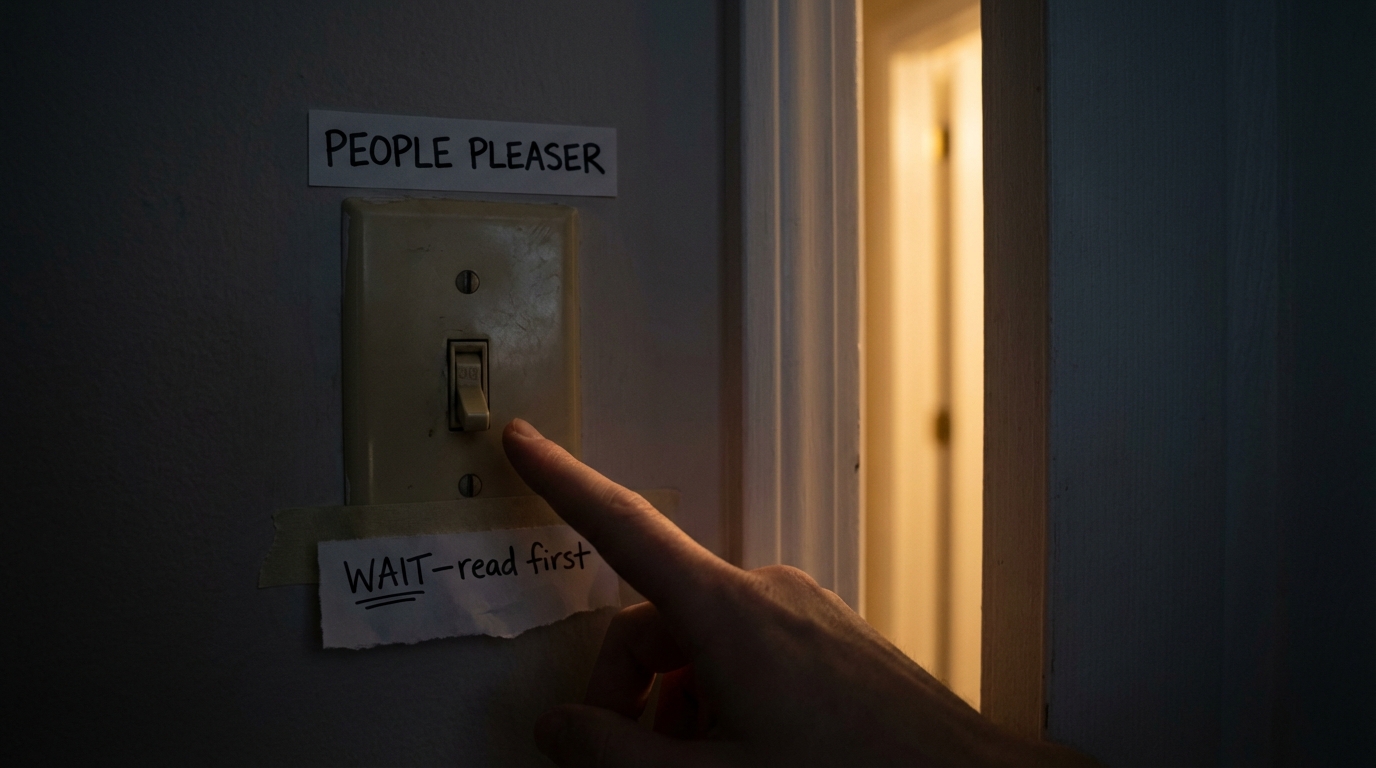
By the end of this page, you will say no without guilt — and your shoulders will finally stop keeping score.
Giving Until It Hurts? Reclaim Your Health Through Strategic Self-Advocacy
The People Pleaser Pattern Guide
You're the reliable one. The person who shows up, who gets things done, who handles what others can't. You've presented at conferences while in severe pain. You've taken on seven extra projects because your colleagues couldn't finish them. You've watched your sister treat your home like a hotel while you silently absorbed the stress.
And your body keeps score.
Maybe it's the shoulders that clench the moment someone asks for something. The neck that tightens before you've consciously registered the request. The pain that used to be occasional but now shows up multiple times a day.
You've probably told yourself it's just stress. Or that you need to be tougher. Or that a good person doesn't complain.
But what if the approach you've been taking—the pushing through, the accommodating, the waiting until you absolutely can't continue before you rest—is exactly what's making everything worse?
Pain Myths Made Simple
Here's what conventional wisdom says:
- • Pushing through pain means you're strong
- • Taking breaks before you need them is lazy
- • Putting others first makes you a good person
- • Asking "what's in this for me?" is selfish and cold
If you've been living by these rules, you're not alone. Most people believe them.
And most people are trapped in a cycle they can't see.
Because here's what actually happens when you follow this advice: You work at 70% capacity, pushing through discomfort, until your body forces you to stop. Then you crash. Hard. Sometimes for days.
Think about your own pattern. When you finally do break, what happens to the rest of your day? The next day? How many things have you cancelled, how much work have you missed, because you pushed past the breaking point?
Researchers who study chronic pain have a name for this. They call it the boom-bust cycle.
The Simple Guide to Boom-Bust Cycles
The boom-bust cycle works like this: On good days, you push hard. You feel relatively okay, so it seems wasteful to stop. You work at full capacity—or beyond it—until your body can't sustain it anymore.
Then comes the bust. The flare. The crash that takes you out for days.
Here's the part nobody tells you: This pattern doesn't just cost you recovery time. It actually retrains your nervous system to become more sensitive to pain.
If the boom-bust cycle continues, research shows that good days become less frequent and shorter. Flares become more regular, longer, and more severe. Each time you push to the breaking point, you're essentially teaching your body to sound the alarm earlier and louder next time.
So all those times you were proud of yourself for presenting through the pain? For pushing through when others would have stopped? You weren't being tough. You were making your condition worse.
This isn't a character flaw. It's just how the nervous system works. Pain and stress feed into and exacerbate each other through overlapping physiological mechanisms. The more you push through, the more sensitive your system becomes.
Body Signal Reading That Works
Now consider what happens when your sister asks to stay at your house three nights a week.
What's your first physical response? If you're like most people caught in this pattern, your shoulders immediately tense. A knot forms in your neck. Your body responds before you've consciously decided anything.
That's not a coincidence. Your body doesn't distinguish between "I should help my sister" and "I should take on this extra project." It just registers: threat, brace, protect.
And then you override the signal. You tell yourself a good person would say yes. You feel guilty for even hesitating. You start looking for ways to make it work, even though something in you is screaming that this isn't right.
Maybe you've noticed that her recent "improved behavior"—the helping around the house, the being nicer—seemed to be leading somewhere. Your gut suspected it was strategic preparation for making this request. But suspecting that feels cynical. Cold.
So you push those feelings down, just like you push through the pain.
Same pattern. Different arena.
Self-Advocacy Without the Guilt
Here's where things get counterintuitive.
You've probably heard that asking "what's in this for me?" is selfish. That prioritizing your own needs makes you a bad person.
But research in clinical psychology tells a completely different story.
Studies on assertiveness have found something striking: Assertiveness is inversely correlated with depression, anxiety, and low self-esteem. Treatment outcome research shows that when people learn to advocate for themselves—when they start asking "what do I get from this?"—their symptoms of depression and anxiety actually decrease. Their self-esteem improves.
Meanwhile, the pattern you've been following? The always-accommodating, never-asking-for-anything, putting-everyone-else-first approach? Unassertiveness is associated with increased social anxiety, lower self-esteem, and poorer mental health outcomes.
Read that again.
The thing you thought was selfish is actually healthy.
The thing you thought made you a good person—always accommodating everyone—is what's been hurting you.
Quick Break-Taking Tips
Once you see this pattern, you can interrupt it. But it requires flipping your approach entirely.
Instead of waiting until the breaking point, you act before you get there.
With your body, this means taking breaks before you lose concentration. Before you're in significant pain. Not after.
This feels wasteful at first. When you're feeling okay, stopping seems unnecessary. But here's the math: Taking proactive breaks means you work at 85% consistently. Waiting until you crash means you work at 70% for a while, then 0% for days.
Research on chronic pain management confirms this. Effective pacing—working with your body instead of against it—leads to pain management, improved self-efficacy, and increased functional ability. It prevents the escalation that comes from boom-bust cycling.
With boundaries, the shift is similar. Instead of waiting until you're overwhelmed, resentful, and breaking down, you decide in advance what you will and won't accept.
Ask the question: How does this benefit me?
When you applied that question to your sister's request, what did you find? If the answer is "nothing"—if agreeing means minimal rent, no household help, more stress, and watching someone treat your home like a hotel—then the answer is no.
That's not cold. That's clarity.
Boundary Setting That Works
Here's what this looks like in practice:
For your body:
- • Block time in your calendar for breaks before you need them
- • Establish a sustainable baseline below your maximum capacity
- • Treat breaks as strategic pain management, not laziness
- • Stop measuring your worth by how much pain you can endure
For your boundaries:
- • Have the direct conversation: decline the three-nights-a-week request
- • Get a specific move-out date—no more "we'll figure it out"
- • Stop leaving things open-ended (vague boundaries don't work; research shows clear limits reduce psychological distress and burnout risk)
For your work:
- • Negotiate workload redistribution at your return-to-work meeting
- • Remember: taking on seven extra projects because others couldn't finish them wasn't your problem to solve
- • After your breakdown, management is already treading carefully—you have more leverage than you realized
Breaking Old Patterns the Right Way
You've probably been told to practice self-care before. To take breaks. To set boundaries.
What makes this different?
Now you understand why.
Before, breaks felt like giving in. Now you see they're strategic—they prevent the crashes that cost you days and prevent your nervous system from becoming more pain-sensitive.
Before, saying no felt selfish. Now you recognize it as evidence-based self-advocacy that actually improves mental health outcomes.
Before, you thought toughness meant enduring. Now you understand that real toughness means making the harder choice: stopping before you break, saying no before you burn out, protecting your capacity instead of depleting it.
Six months ago, you couldn't have considered refusing your sister's request. The fact that you can now? That's significant progress.
Setting Boundaries Without the Guilt Trap
There's one more piece to address: the guilt.
Even when you know intellectually that setting a boundary is the right thing, guilt has a way of showing up. You might still feel bad for your sister, even knowing that her "improved behavior" was strategic preparation for this ask.
That guilt can sabotage follow-through. It can make you soften your no into a maybe, or leave the move-out date vague, or take on just one more project even though you know better.
Understanding where that guilt comes from—and what to do with it—is what separates people who set boundaries once from people who maintain them consistently.
But that's the next layer of work.
For now, you have what you need: the pattern made visible, the evidence that supports a different approach, and specific actions that work with your body and your life instead of against them.
The question isn't whether you deserve to take care of yourself.
The question is whether you're willing to stop waiting for permission.
What's Next
Where does the guilt come from when setting boundaries, and how do you prevent it from sabotaging follow-through even when you intellectually know the boundary is right?




Comments
Leave a Comment