

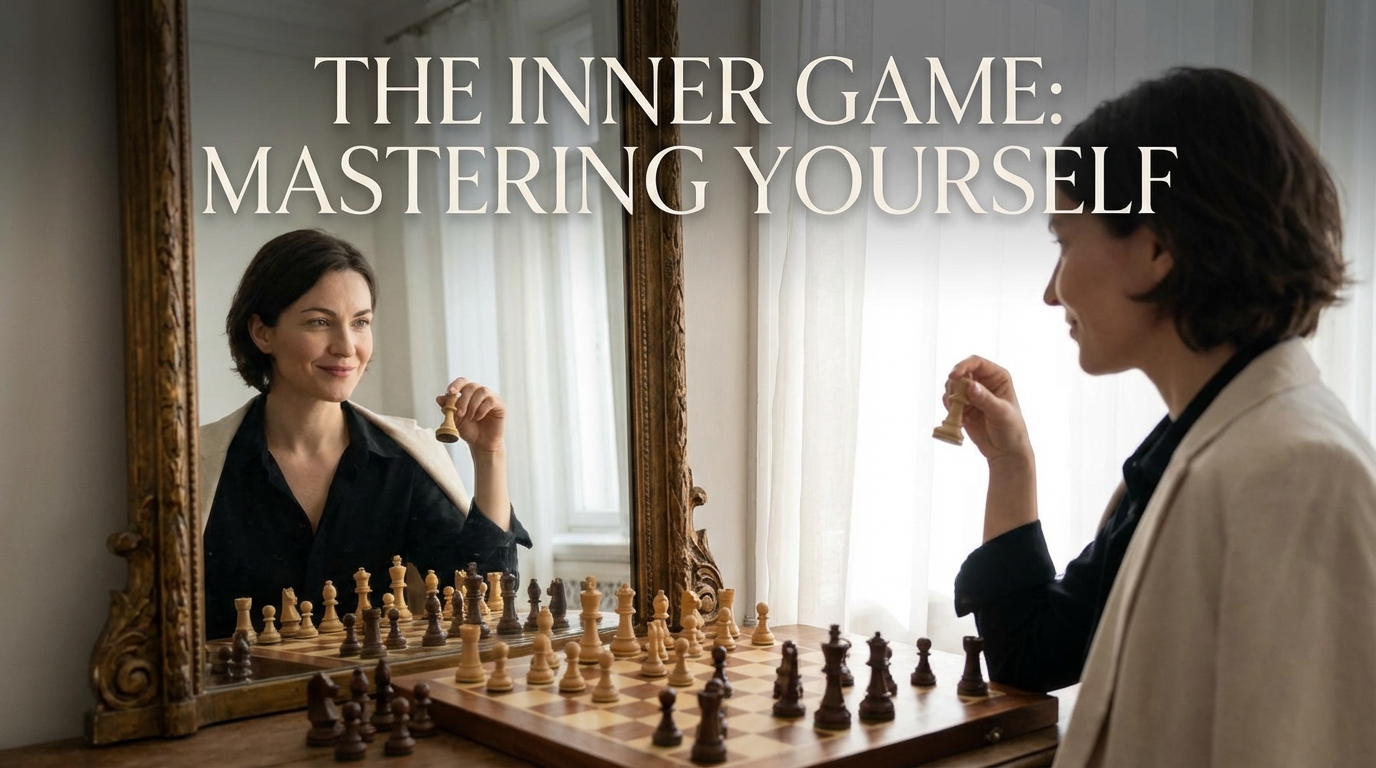
The Monitoring Voice Trap
You're standing at the kitchen sink, hands in warm soapy water, trying to focus on the lemony smell of the washing up liquid. You watch the bubbles form as water moves across the surface. You count how many times you scrub the mug.
And then the voice appears.
I know what you're doing. I know you're trying to distract yourself from the anxiety. And it's not going to work.
Sound familiar?
This is what I call the meta-experience trap. Your brain catches you trying to cope, calls you out on it, and suddenly you're fighting two battles—the original anxiety AND the argument with yourself about whether your coping strategy is legitimate.
Most people assume the problem is that they haven't found the right distraction technique yet. Or that they need to get better at shutting that voice down.
But what if the monitoring voice isn't a sign you're doing something wrong?
What if the monitoring IS the problem?
Why Watching Yourself Makes Anxiety Worse
When that voice says "I know what you're doing," it feels like a necessary check. Like your brain is being honest with you. Like you need to evaluate whether your coping is working.
But here's what that voice is actually doing: keeping your attention locked on yourself.
Think about it. Where is your attention when you're monitoring whether the distraction is working? On the distraction? No—on YOU. On whether you're doing it right. On whether it's helping. On what you're trying to escape.
Research on attention patterns has identified something interesting: self-focused attention—the act of monitoring yourself—doesn't just fail to help. It actively makes anxiety worse.
And here's the part that surprised me when I first learned it: this isn't something unique to anxious people. Studies show that self-focused attention increases feelings of anxiety and makes people appear more anxious to others in everyone. Not just people who struggle with anxiety. It's a universal pattern.
The monitoring voice isn't protecting you. It's keeping your attention exactly where it causes the most damage.
Why 'Distraction' Is the Wrong Word
Here's where the common assumption falls apart.
When most people try to manage anxiety, they frame what they're doing as "distraction." And that framing carries baggage. Distraction sounds like avoidance. Like running away. Like something that shouldn't really work.
Your brain knows this, which is why it objects: You're just avoiding the problem.
But researchers have discovered something counterintuitive: the brain responds differently to distraction techniques than it does to what they call external attention training—even when the activities look identical on the surface.
In controlled studies, attention training techniques caused large reductions in self-focused attention. Distraction tasks? No change at all.
Same activity. Completely different results.
The difference isn't what you're doing. It's how you're framing what you're doing.
"Distraction" says: I'm running away from something.
"External attention" says: I'm choosing where to put my focus.
One keeps you tethered to the thing you're supposedly escaping. The other actually moves you somewhere else.
This is why the washing up exercise can work beautifully one time and fail completely the next. When you're genuinely absorbed in the lemony smell and the moving water and the counting—you're not fighting anything. You're just somewhere else. But when you're "trying to distract yourself," you're still mentally anchored to what you're distracting from. The monitoring voice has a foothold.
Redirect, Don't Fight
If you've worked in marketing—or really any field that tracks performance—you know this intuitively:
When a channel isn't performing, you don't waste resources trying to fix a broken channel. You shift resources to what's actually working.
You don't fight the underperformer. You redirect.
So what if that's the answer for the monitoring voice too?
Not: "How do I switch it off?"
But: "How do I redirect my attention so fully that it doesn't have anywhere to run?"
The difference is enormous. Fighting the voice is another internal activity—you're still focused on yourself, just in a different way. Redirecting externally is actually going somewhere else.
The monitoring voice can't follow you outside your head. It can only operate in the space where you're watching yourself. Get fully absorbed in something external, and there's nothing left for it to latch onto.
This is what happened with the dishes. You weren't fighting with yourself about whether the lemony smell was "really working." You were just... there. Outside your head. And when you came back, you realized: I didn't notice myself fighting that time.
The Gaming Levels Approach
Here's what most people get wrong about this: they expect it to work perfectly the first time.
If you've played video games, you know better. Nobody beats the boss on level one and expects to immediately win on level ten. You build skill at one level, then move to the next.
External attention works the same way. Washing dishes is level one—a quiet, controlled environment with minimal distraction. Dog walking might be level two—more stimulation, more chances to slip back inside your head. Cooking dinner, level three. Team calls with their social pressure and expectation to respond quickly? That's level five or six.
You're not failing if team calls are still hard. You're just not there yet.
This maps directly to how evidence-based anxiety treatment actually works—graded exposure, stepwise mastery. You build capacity at one level before moving to the next. Each successful practice at a lower level strengthens your ability to access external focus when the stakes are higher.
The 'Yes But' Mistake That Erases Your Wins
There's one more hidden saboteur we need to talk about.
Even when external attention works—even when you get through situations you previously would have walked out of—something keeps erasing the evidence.
Yes, I got through that meeting. But I should have done better.
Yes, I stayed when I used to leave. But other people wouldn't have struggled at all.
Yes, but...
This pattern has a name: discounting the positive. And it's not just negative thinking. It's a recognized cognitive pattern that maintains negative beliefs by dismissing any evidence that contradicts them.
Think about it like this: imagine your marketing team dismissed every positive metric. Yes, engagement is up, but it should be higher. Yes, conversions improved, but competitors are probably doing better.
What would happen?
You'd never know what was actually working. You'd keep changing things that didn't need changing. And the team would burn out because nothing ever felt like progress.
That's what "yes, but" thinking does to you. Every small win gets explained away before it can register. No matter how many times you prove yourself, you never feel like you're getting anywhere—because you've already discounted the evidence.
Three Skills You Actually Need
So we're actually talking about three distinct skills:
1. External Focus—Staying outside your head rather than "distracting yourself." The foundation that makes everything else possible, because when you're genuinely absorbed externally, you're not monitoring OR judging.
2. Giving Yourself Leeway—Not expecting perfection. Recognizing that level-three struggles are normal when you're still building level-three skills. This isn't self-indulgent; research shows self-compassion acts as a significant buffer against perfectionism's harmful effects.
3. Acknowledging Small Wins—Catching the "yes, but" pattern before it erases evidence. Creating external proof your brain can't dismiss.
These skills connect. When you don't give yourself leeway, you monitor more harshly. When you discount wins, you don't build confidence for harder levels. External focus is the foundation—but it needs the other two to actually accumulate into lasting change.
How to Start Right Now
Reframe the Language
Stop saying "I'm trying to distract myself." Start saying "I'm choosing where to put my attention" or "I'm staying outside my head."
This isn't semantic games. Research shows these frames produce measurably different results. The words you use shape what your brain does.
Build Your Levels
Identify your progression:
- Level 1-2: Safe, controlled activities (dishes, folding laundry, simple cooking)
- Level 3-4: More stimulation, more chances to slip back inside (walking outside, cooking complex meals)
- Level 5-6: Social pressure, performance expectations (team calls, meetings, conversations)
Practice at your current level until external focus feels more accessible. Don't rush to harder levels. You're building a skill, not proving something.
Create External Evidence
Start a simple progress log. Not to judge yourself—just to have evidence you can refer back to when the "yes, but" voice shows up.
Write down moments when:
- You stayed outside your head longer than expected
- You got through something you might have walked out of before
- You caught yourself about to discount a win
This creates external proof your biased internal accounting can't dismiss. When your brain says "you're not making progress," you'll have documentation that says otherwise.
When the Monitoring Voice Appears
Don't fight it. Don't try to silence it.
Just redirect—fully. Go so completely into the lemony smell, the changing leaves, the moving water, that there's nothing left for the voice to grab.
The voice can only operate in the space where you're watching yourself. Get absorbed enough in something external, and you've left that space entirely.
What This Makes Possible
Something shifts when you stop fighting your brain and start redirecting it.
The monitoring voice doesn't go away—but it has less and less to work with. External focus becomes more accessible. The gaming levels start to feel less like tests and more like natural progression.
And somewhere along the way, you might notice something unexpected: you've been a little bit kinder to yourself. You got through situations where you previously would have walked out.
You didn't "yes, but" it.
You just let it count.
References
- Spurr, J. M., & Stopa, L. (2002). Self-focused attention in social phobia and social anxiety. Clinical Psychology Review, 22(7), 947-975. https://doi.org/10.1016/S0272-7358(02)00107-1





Comments
Leave a Comment