

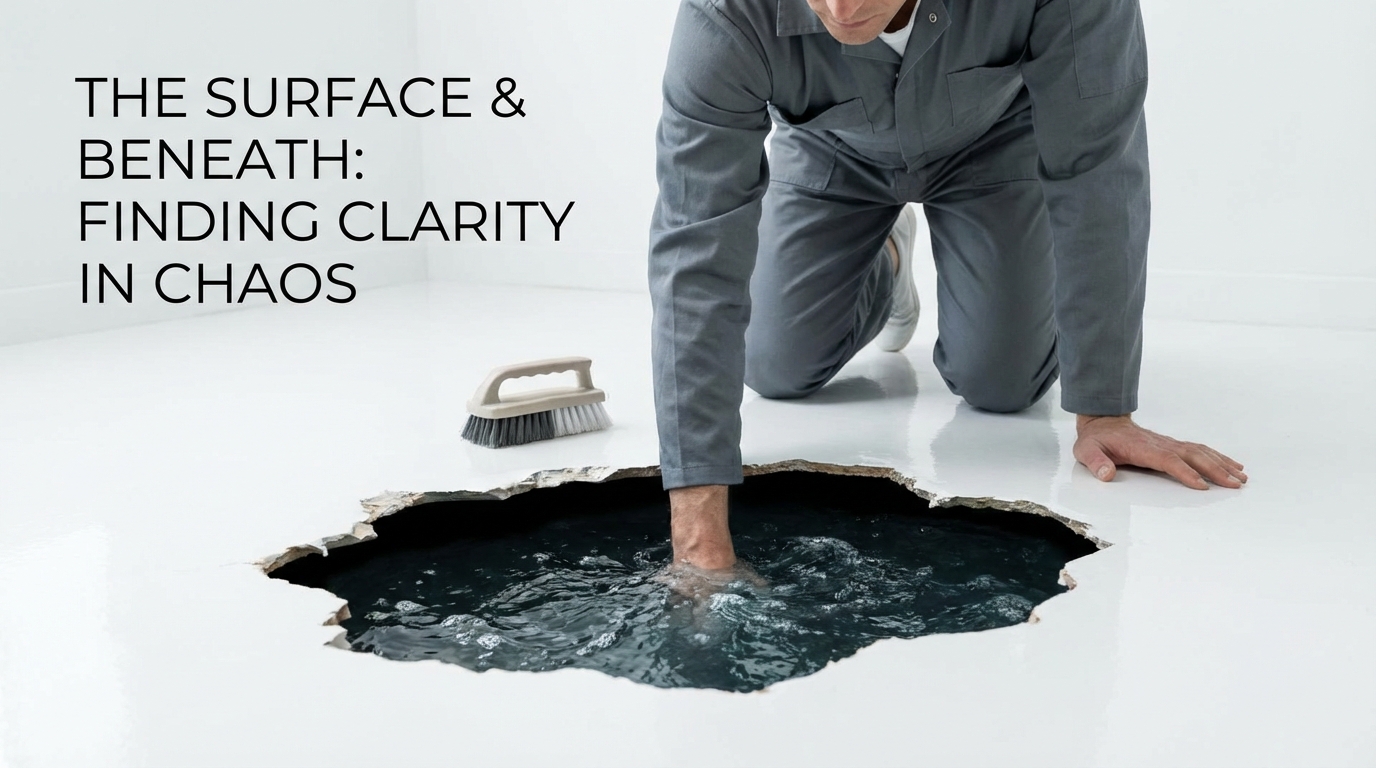
You finish wiping the floor, the toilet seat, the handles, the tap. Then you wipe yourself down with antibacterial wipes. One minute, one wipe per surface. And for a moment—relief.
But here's the strange thing someone noticed when they started delaying these rituals: the intrusive thoughts didn't pile up. They didn't get louder or more insistent, the way they'd always threatened to.
They actually got quieter.
If you've ever wondered why your rituals seem to demand more and more of you—why the relief never quite lasts—what you're about to discover changes everything.
Why Does the Relief Never Last?
The logic seems airtight: Do the ritual, anxiety goes down. Skip the ritual, anxiety goes through the roof.
So you keep doing it. Floor. Seat. Handles. Tap. Yourself.
Maybe you worry about flakes of toilet paper on the floor. Maybe you worry about surfaces you touched with hands that aren't clean enough. Maybe—like many people—you have someone you love who is vulnerable, and the thought that contamination could travel from you to them is unbearable.
The ritual promises protection. Safety. Control.
But if the ritual was actually solving the problem, wouldn't you need it less over time, not more?
If the alarm was correct, and the ritual was the answer, why does the alarm keep going off?
The Truth About Your Brain's Alarm System
Your brain has a threat detection system running constantly in the background. When it perceives danger—even potential danger—it fires an alarm. That alarm comes with physical sensations: unease, tension, the urgent need to do something.
Here's what most people don't realize about this system: it learns.
And it learns based on what you do next.
When you complete a ritual immediately after an intrusive thought, you're sending your brain a very specific message: "Good call. That WAS dangerous. I needed to do something about it."
The alarm system receives this feedback and stores it. Okay, threat confirmed. Keep firing in these situations.
Research shows this is exactly why compulsions maintain obsessions. The ritual doesn't solve the problem—it trains the alarm to keep sounding.
But when you delay or skip the ritual and nothing bad happens?
The alarm learns it was a false alarm.
Your brain forms a new, competing memory: "This situation looked dangerous, but it wasn't." Scientists call this inhibitory learning. And studies on this approach show about 86% of people respond to treatment based on this principle, compared to only about 32% who use other anxiety management strategies.
The difference isn't small. It's enormous.
What Nobody Tells You About Skipping Rituals
This means the standard approach—do the ritual to reduce anxiety—is exactly backwards.
The ritual reduces anxiety in the moment. That's real. That feeling of relief isn't imaginary.
But it increases anxiety over time by strengthening the alarm's conviction that it was right to fire.
The counterintuitive truth: not doing the ritual is how you actually weaken the alarm.
Think about what happens at work, or in other situations where you can't do your full routine. The anxiety spikes at first. But if you don't neutralize it—if you let it be there without responding—something shifts. The alarm learns. And gradually, it gets quieter.
This isn't theory. It's something you may have already experienced without realizing what was happening.
The Responsibility Mistake That's Hurting Your Peace
Here's where it gets personal.
Maybe you have someone in your life who is genuinely vulnerable. A grandmother in a care home. Someone with dementia who had a fall. Someone whose health is fragile.
The fear isn't crazy. The love driving it is real.
But consider this: Who else interacts with this person?
Care home staff who see them every day. Other visitors. Other residents. Delivery people. Medical professionals. Dozens of people coming and going.
Are all those people wiping themselves down with antibacterial wipes after every bathroom visit?
They're using standard hygiene—washing hands, basic cleanliness. And your loved one has been in that care home, surrounded by all those interactions, and hasn't gotten sick from the things you fear.
The research on inflated responsibility in anxiety shows this pattern clearly: when people feel overly responsible for preventing harm, they develop safety behaviors that seem necessary but don't actually prevent anything the world isn't already handling normally.
Your small slice of that responsibility pie is just that—a small slice. The fear has inflated it to feel like the whole pie.
Why Exposure Setbacks Aren't What You Think
There's another piece that trips people up: exposure work.
Maybe you tried to face a fear—watching certain videos, for instance—and it went badly. You felt physically sick. You couldn't try again for days. And you felt like a failure.
Here's the reframe that changes everything: struggling with an exposure step isn't failure. It's diagnostic information.
It tells you that you jumped too high on the ladder.
Exposure work is designed to be graduated. You don't start with the hardest thing. You start with something uncomfortable but manageable—maybe just writing a word repeatedly, or looking at a black-and-white image. When that gets easier, you move up.
Research on specific phobias shows that one in five people initially struggle with or refuse exposure work. This is normal. The solution isn't to white-knuckle through the hardest step—it's to find the step where you can stay engaged without your brain completely shutting down.
If spelling a word repeatedly was manageable, that's your current ceiling. Master that. Then move to the next step.
The goal isn't to survive the worst thing through sheer willpower. The goal is to systematically teach your brain that these situations are safe—and that requires pacing.
The Evidence You Already Have
Here's what might surprise you: if you've made progress anywhere, you've proven the mechanism works.
Maybe you used to need a shower after work every day, and now you don't. Maybe you can use a toilet at work without feeling contaminated afterward. Maybe your intrusive thoughts have gotten quieter since you started delaying your responses to them.
That's not a fluke. That's the alarm learning.
The work bathroom, the bathroom at home, worries about loved ones—they're all the same mechanism. The same alarm system that learned to quiet down in one context can learn to quiet down in others.
You're not starting from zero. You're extending what already works.
How to Finally Start Breaking Free
Start with the lowest-anxiety piece of your routine.
If wiping yourself down feels like the core of it—the non-negotiable—don't start there. Start with something that feels less critical. Maybe the floor wipe. Maybe one of the handles.
Skip that one step. Let the anxiety come. Don't neutralize it.
Watch what your brain learns.
For exposure work you've been avoiding: find the step that's uncomfortable but survivable. If videos are too much, go back to images. If colored images are too much, try black-and-white. If images are too much, work with words.
The hierarchy exists because each step builds the foundation for the next.
And when the alarm fires, remind yourself: This is the alarm learning. When I don't respond, it learns this was a false alarm. That's how it gets weaker.
You already know this works. You've felt it happen. Now you understand why it works—which means you can apply it deliberately, everywhere the alarm goes off.
What's Next
What happens next? Once you understand how to weaken the alarm at home, a new question emerges: How do you handle this in unfamiliar environments? New bathrooms, different routines, situations where your usual approach isn't available. That's where the real test begins—and where many people discover strengths they didn't know they had.



Comments
Leave a Comment