

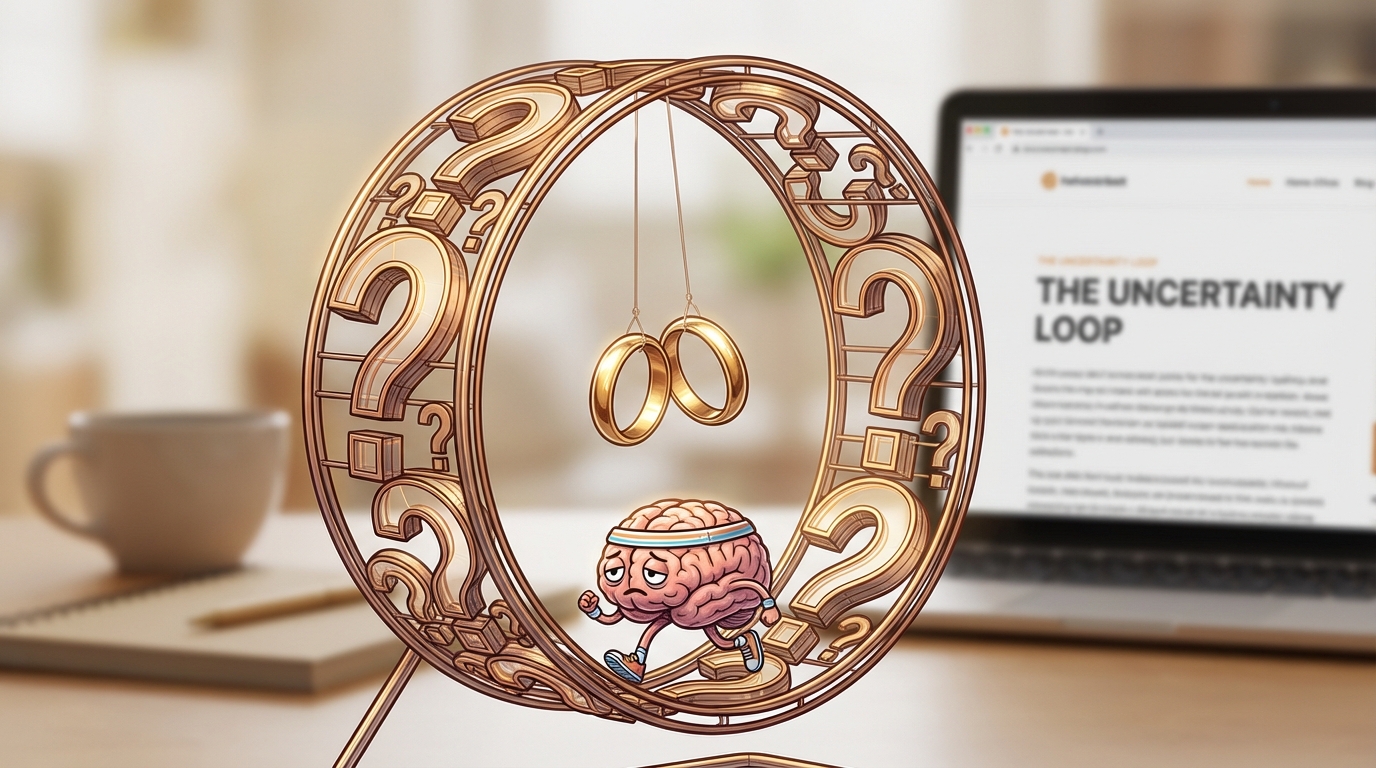
The uncomfortable feeling starts in your stomach the moment they mention going out.
Where are you going? Who's going to be there? What time will you be back?
You try to keep the questions inside. But they push their way out anyway. And sometimes you find yourself asking the same thing in different ways—not because you forgot the answer, but because you're scanning for inconsistencies. Testing whether the story changes.
You know what this feels like. You've probably described yourself as "like a dog with a bone" when it comes to these questions.
And here's what makes it so frustrating: the questions don't actually make you feel better. Not really. Maybe for a few minutes, if the answer sounds right. But then another question surfaces. Another detail to verify. Another inconsistency to investigate.
If questioning your partner actually solved jealousy, here's what should have happened by now: you should feel more secure than when you started.
But you don't, do you?
If anything, it's gotten worse. And there's a reason for that—one that might change everything about how you approach this pattern.
The Questioning Mistake That's Training Your Brain Wrong
When you ask a question and your partner gives you an answer that sounds reasonable, you feel relief. The stomach feeling eases. For a moment, everything feels okay.
But what happens next?
Within minutes, you're replaying what they said. Looking for holes. Thinking of the next question.
Research on anxiety and reassurance-seeking has identified something important here: that relief you feel isn't actually teaching your brain that your partner is trustworthy. It's teaching your brain something else entirely.
It's teaching your brain that the questioning is what made you safe.
Think about it like this: if you took a medication that only worked for a few minutes before you needed another dose, and you kept needing more doses, more frequently—what would you call that?
Dependency. Your brain is becoming dependent on the questioning itself.
Every time you question and feel that brief relief, you're running a training session. And the lesson your brain learns isn't "My partner is faithful." The lesson is "I needed to ask that question to be safe."
The questioning behavior gets the credit. Your partner's actual trustworthiness? Your brain never gets to learn about that—because you always "check" first.
Why Your Partner Started Hiding Things From You
Here's where the mechanism reveals something uncomfortable.
You may have noticed your partner has started hiding things from you. Not because they're doing anything wrong—but because they're trying to avoid the interrogation.
They don't mention if they went to a nightclub. They're vague about who was there. They've learned that certain details trigger a cascade of questions, so they've started leaving those details out.
And what does their evasiveness do to your suspicious thoughts?
It feeds them. "See? They ARE hiding something."
But here's the trap you've built without realizing it: they're hiding things because of your questioning. Your questioning is creating the exact situation that makes you more suspicious.
This is what research calls a self-perpetuating mechanism. The behavior you use to feel safe is actively making the situation less safe. Years of questioning have left you less secure than when you started—and now your partner has learned to be guarded around you.
What Your Own History Is Doing to Your Relationship
If you've had your own history with infidelity—perhaps in your 20s or 30s—that history isn't just sitting quietly in the past.
Studies on relationship psychology show that people who have cheated, or had desires to cheat, are more likely to project those tendencies onto their partners. It's not a character flaw. It's a cognitive pattern: you know what you were capable of, so some part of your brain assumes your partner must be capable of it too.
This doesn't mean your concerns are invalid. But it does mean your brain may be running a biased surveillance program—one that's searching for evidence of something you already expect to find.
All your questioning hasn't uncovered anything. Your partner hasn't actually done anything wrong. But your brain keeps searching, because it can't shake what it knows about human nature from your own experience.
Why Seeking Reassurance Will Never Build Trust
So here's the counterintuitive truth that changes everything:
You cannot question your way to trust.
Every question you ask is a missed opportunity for your brain to learn that things are okay without the question. And here's what's even more uncomfortable—when you seek reassurance from your partner, you're not just managing your own anxiety. You're transferring responsibility to them.
Research shows that excessive reassurance-seeking functions similarly to compulsive checking, with one added feature: it puts the burden on another person. Your partner isn't just answering your questions—they're being put on trial, repeatedly, for crimes they haven't committed.
No wonder they're exhausted. No wonder they've become evasive. They've been cast as the defendant in a case that never closes.
How to Break the Cycle By Doing the Opposite
If you've tried to manage jealousy by questioning more carefully, more strategically, or more "casually"—you've been solving the wrong problem.
The solution isn't better questions. It's no questions.
This is what some therapists call "going opposites." When your partner goes out and your stomach starts churning, you don't ask where they're going. You don't ask who will be there. You don't ask what time they'll be back.
When they come home, you ask one thing: "How was your evening?"
And then you stop.
No follow-up questions. No scanning for inconsistencies. You let the discomfort sit there—the churning stomach, the racing thoughts, the urge to interrogate—and you don't seek relief through questions.
This will feel unsafe. That's the point.
Because when you don't question, and the evening passes, and nothing bad happens—your brain gets to learn something it's never had the chance to learn: I didn't need to ask. Everything was fine. My partner is trustworthy.
This is how the dependency breaks. Not by getting better reassurance, but by discovering you don't need reassurance at all.
Your Relationship Is Code You Never Let Run
If you work with software—or even if you don't—think about it this way:
When you're testing code, what happens if you never let it run without debugging tools watching every step?
You never know if it can run on its own. You never trust it to work without monitoring.
Your relationship is the same. You've been running constant debugging checks—never letting it operate without surveillance. So you've never had the chance to discover that it works fine on its own.
To build trust, you have to let the code run. You have to step back from the monitoring. You have to give your brain the experience of not checking and finding out everything is okay.
That's not faith. That's not naivety. That's how your brain actually learns to trust—through experience, not through reassurance.
The Discomfort You'll Need to Sit With
Let's be honest about what this requires.
When you don't question and you feel that uncomfortable stomach feeling, you're not ignoring it. You're not stuffing it down. You're tolerating it—without reaching for the quick relief of a question.
This is hard. The urge to ask "just one question" will feel almost physical. Your brain will tell you that you need to know, that the discomfort is unbearable, that something terrible will happen if you don't check.
But here's what research on exposure therapy shows: when you experience discomfort and the feared outcome doesn't happen, your brain forms new associations. It learns that the situation is safe—not because you got reassurance, but because you didn't get reassurance and everything was still fine.
The surprise of nothing going wrong is actually more powerful for your brain than any answer your partner could give you.
Discomfort is not a signal that you need to question. Discomfort is the price of breaking the dependency. It's the toll you pay on the road to actual trust.
5 Steps to Try the First Time Your Partner Goes Out
You don't have to overhaul everything at once. Start with one evening.
The next time your partner goes out:
- 1. Notice the urge to question. Don't fight it. Just notice it. Name it: "There's the urge."
- 2. Don't act on it. No questions about where, who, or when. Let the information gap stay open.
- 3. When they return, say: "How was your evening?" Then stop. No follow-ups.
- 4. Let the discomfort sit. Your stomach will churn. Your mind will race. That's okay. You're not in danger—you're in learning.
- 5. Notice what actually happens. The evening passes. Nothing bad occurred. Your brain just collected evidence that questioning wasn't necessary.
One evening is enough to start. Do this a few times, and you'll begin to feel the dependency loosening. Your brain will start to form new associations: partner goes out → everything is fine → I don't need to interrogate.
This is how trust gets built. Not through better surveillance—through the courage to stop surveilling.
What Happens When You Finally Stop Checking
When you stop questioning, something else becomes possible.
Your partner stops being evasive—because there's nothing to evade. They can mention the nightclub without bracing for an interrogation. They can share details without worrying those details will be used against them.
And you get something you've never had: the experience of genuine trust. Not the temporary relief of reassurance, but the settled confidence that comes from your brain actually learning your relationship is safe.
The uncomfortable feeling in your stomach? It doesn't go away immediately. But it transforms. Instead of being a signal to interrogate, it becomes a sensation you can tolerate—a brief discomfort that passes without requiring action.
You've been gripping this relationship with white knuckles, convinced that control would keep it safe. But the tighter you grip, the more it slips away.
What happens when you open your hands?
What's Next
How do I handle the intense discomfort that comes up when I don't question? What do I do with all that energy that wants to interrogate?
References
- Kobori, O., & Salkovskis, P. M. (2017). Why do people with OCD and health anxiety seek reassurance excessively? An investigation of differences and similarities in function. Cognitive Therapy and Research, 41(4), 619-631. https://doi.org/10.1007/s10608-016-9826-5




Comments
Leave a Comment